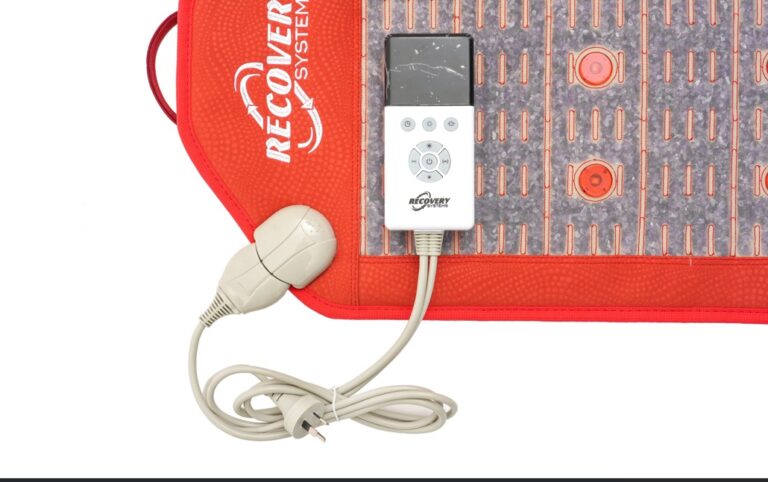

How Does PEMF Therapy Work?
Last Updated::
Pulsed Electromagnetic Field therapy has one of the most substantial bodies of evidence in non-invasive medicine, yet most people still ask the same question when they first encounter it: what is actually happening inside the body? Whether you are weighing up a PEMF mat, following a practitioner’s recommendation, or trying to separate the science from the marketing, this article walks you through the full picture in sequence, covering PEMF therapy how does it work at a cellular level, what the research supports, and how to use it effectively.
What Is PEMF Therapy?
PEMF stands for Pulsed Electromagnetic Field. The therapy delivers brief, repetitive bursts of electromagnetic energy to the body at low frequencies, typically between 1 Hz and 100 Hz, through a coil-based device.
These pulses are not static magnets. They are not the same as the electromagnetic radiation emitted by mobile phones or Wi-Fi. In character, they are closest to the naturally occurring geomagnetic fluctuations that living organisms have evolved alongside for millions of years.
A Brief History
PEMF has been used clinically since the early 1970s, when pioneering work by Drs. Andrew Bassett and Arthur Pilla demonstrated that electromagnetic pulses could stimulate bone repair.
By 1979, that evidence was strong enough for the US Food and Drug Administration to formally approve PEMF for the treatment of non-union fractures. According to a follow-up study covering 1,382 patients, PEMF stimulation achieved an overall success rate of 89.6% for non-union fractures.
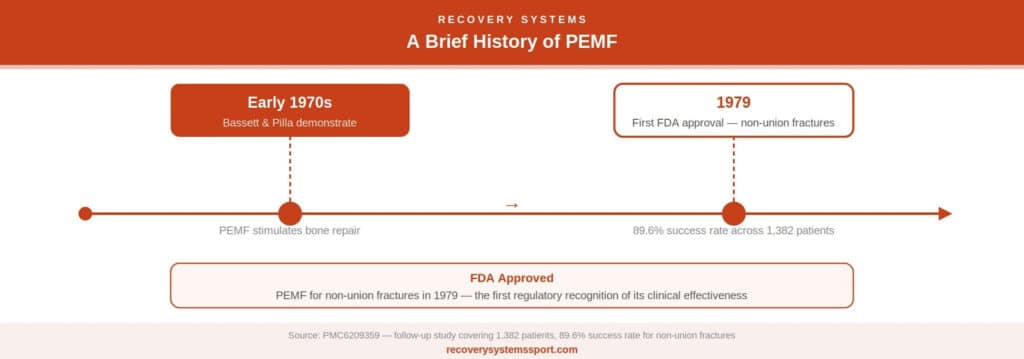
PEMF in clinical use since the early 1970s — FDA approved for non-union fractures in 1979, with an 89.6% success rate across 1,382 patients.
What Does PEMF Do to Your Body?
PEMF works by interacting with the body at a cellular level through three mechanisms that are consistently documented across the research literature.
Mechanism 1: Ion Channel Activation
The electromagnetic pulses interact with voltage-sensitive ion channels on the cell membrane, prompting the movement of calcium, potassium, and sodium ions. Calcium ion influx in particular triggers a downstream signalling cascade that regulates cell metabolism, protein synthesis, and inflammatory response, directly stimulating the cellular processes involved in tissue repair and recovery. Because PEMF-generated magnetic fields penetrate all tissues with little to no attenuation, as confirmed by the PMC physiological response overview, this activation occurs at depth rather than at the surface, reaching bone, joint, and muscle tissue where repair is actually needed.
Mechanism 2: Adenosine Receptor Signalling
A PMC review on PEMF and skeletal response identifies A2A and A3 adenosine cell membrane receptors as key sites of action. Activation of these receptors helps explain PEMF’s anti-inflammatory and chondroprotective effects, since adenosine signalling plays a central role in regulating inflammation and cartilage matrix synthesis.
In plain terms, PEMF appears to “switch on” specific receptors on cell surfaces that tell the body to reduce inflammation and protect cartilage — the same signalling pathway that naturally quiets an overactive inflammatory response.
Mechanism 3: Mitochondrial Support and ATP Production
Adenosine triphosphate (ATP) is the molecule cells use to power virtually every biological process. A Frontiers review on PEMF and exercise reports that PEMF stimulation increases the activity and metabolism of muscle fibres and has been shown to improve tissue oxygenation, microcirculation, and angiogenesis.
An Important Note
ScienceDirect’s overview of PEMF therapy notes that for some applications, particularly pain reduction, more rigorous clinical investigation with standardised parameters is still needed. PEMF is not a cure-all, and understanding its limitations is part of understanding the therapy well.
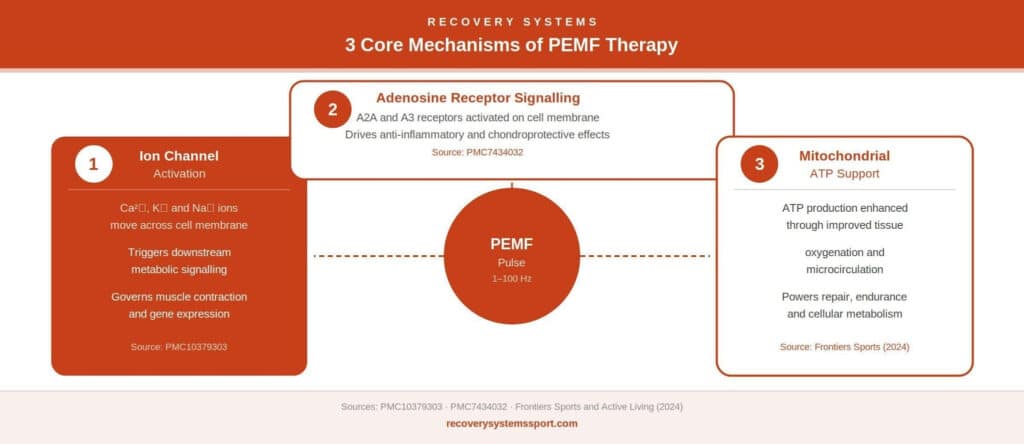
The three mechanisms through which PEMF interacts with the body at a cellular level.
How Does PEMF Work on Bone and Tissue?
- Why Bone Responds to Electromagnetic Pulses
When bone fractures, the body generates its own small electrical field as part of the natural healing cascade. Specialised bone-building cells called osteoblasts respond to this field by proliferating and laying down new matrix. When that process stalls, PEMF essentially replicates and amplifies that biological signal. A Frontiers review on bone and cartilage responses to PEMF confirms that PEMF stimulation enhances bone endogenous healing processes and shows efficacy in the prevention and treatment of osteoporosis and osteoarthritis.
- Effects on Soft Tissue and Muscle
The Frontiers sports review describes both acute and chronic effects on muscle. Acutely, PEMF increases blood flow and reduces inflammation, delivering measurable relief from muscle soreness and faster post-exercise recovery. Chronically, regular use supports overall muscular health, endurance, and performance by promoting cellular repair and optimising metabolic function over time.
How Long Does It Take PEMF Therapy to Work?
- Immediate Effects
Some users report reductions in pain and muscle tension after their very first session. These rapid responses are attributed to enhanced circulation and nitric oxide production, both of which can occur within a single treatment window.
- Short-Term Effects (Days to Weeks)
For most users, the first consistent changes appear within one to two weeks of regular sessions: improved sleep quality, reduced muscle soreness, and a general reduction in localised inflammation.
- Long-Term Effects (Weeks to Months)
For tissue healing and chronic condition management, research shows that PEMF produced considerable improvements in meniscal tear patients after eight weeks of consistent treatment. Studies examining patients with osteoarthritis have similarly reported meaningful reductions in pain scores and improved quality of life. For bone-related conditions, clinical protocols used with patients typically run for 45 to 90 consecutive days.
The Core Principle
The most consistent finding across the literature is that repeated, regular exposure over time matters more than any single session. PEMF supports the body’s own biological mechanisms. It does not produce instant structural change.
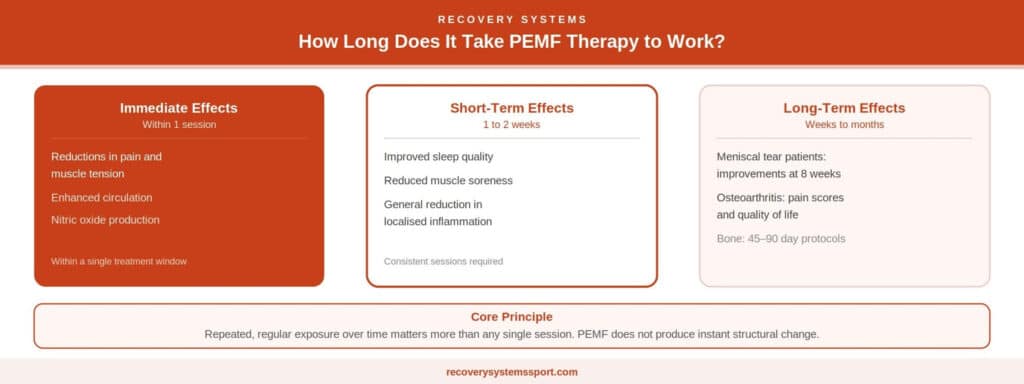
Three phases of PEMF results: immediate effects within the first session, short-term changes over 1-2 weeks, and long-term outcomes over 8-12 weeks.
RECOVERY SYSTEMS PEMF BIO MAT
If you are considering a PEMF mat for recovery, sleep, or pain support, the Recovery Systems Qi Bio Mat combines PEMF with far infrared, red light, negative ion therapy, and heat, giving the body five recovery inputs in a single daily session. → Explore the PEMF Bio Mat Range
Conclusion
PEMF therapy works by delivering low-frequency electromagnetic pulses that interact with the body’s own electrical systems, restoring cell membrane charge, activating ion channels, and supporting ATP production. The result is a therapy grounded in decades of research, with FDA-approved applications and a growing evidence base spanning bone healing, pain management, inflammation, and recovery. It is not a quick fix, but used consistently and within appropriate parameters, it offers a non-invasive way to support the body’s natural capacity to heal itself.
Frequently Asked Questions
How Long Should PEMF Sessions Last?
- General Duration Guidelines
Clinical guidance suggests that treatment durations typically range from 10 to 30 minutes per session. Longer sessions do not necessarily produce better results and may increase the risk of overstimulation.
- What the Studies Used
A Frontiers study on PEMF for chronic pain and anxiety used 20-minute sessions twice weekly and found improvements in aggregate pain scores, alongside deeper sleep, improved mental clarity, and better mood. That protocol illustrates the key principle: consistency over intensity.
- Frequency Settings to Start With
Practitioners cited by Perfect PEMF recommend beginning at 5 to 10 Hz for relaxation and general recovery, or around 10 to 15 Hz for pain relief and musculoskeletal support.
Does PEMF Work Through Clothes?
Yes. Pulsed electromagnetic fields penetrate biological tissue without requiring skin contact, so standard clothing does not impede the therapy. You simply lie on or apply the device through normal clothing, without needing to remove garments or apply conductive gels.
What You Do Need to Remove
Metal items require attention, not because they block the field, but because jewellery and electronic devices can interfere with field distribution or be damaged by the magnetic pulses. Phones, cards with magnetic strips, and metal jewellery should all be set aside before a session begins.
Is PEMF Therapy Safe?
For most people, PEMF therapy is considered safe. It is non-invasive and does not use radiation in any harmful sense. Research across thousands of published studies has consistently found no known toxic side effects at therapeutic intensities. Fewer than 5% of users experience any adverse effects, and these are typically mild and temporary.
Who Should Avoid PEMF
- Those with implanted electronic devices including pacemakers and defibrillators
- Pregnant women, due to the absence of established safety data
- Individuals with active epilepsy or seizure disorders
- People with active bleeding disorders
- Organ transplant recipients on immunosuppression
As with any therapeutic modality, a conversation with a qualified healthcare provider is the appropriate starting point, particularly for anyone managing an existing medical condition. For an independent overview of electromagnetic stimulation therapy safety, the Mayo Clinic’s guidance on electromagnetic therapies provides useful independent context.
What Are the Main Applications of PEMF Therapy?
- Pain Management
PEMF therapy has shown reductions in pain scores for conditions including osteoarthritis, fibromyalgia, lower back pain, and post-surgical recovery. Individual trial quality varies, so measured expectations are appropriate.
- Inflammation Reduction
The PMC review on PEMF and tissue regeneration found that PEMF decreases proinflammatory cytokine production while stabilising or increasing anti-inflammatory output.
- Sports Recovery
The Frontiers sports review positions PEMF as a valuable tool in sports medicine, supporting optimised physical health through improved circulation, tissue oxygenation, and natural healing processes.
- Sleep and Nervous System Regulation
Users and study participants consistently report deeper sleep and reduced anxiety following regular PEMF use. A PMC review on PEMF and tissue regeneration notes that PEMF’s influence on proinflammatory signalling may partly explain improved sleep and mood outcomes, though this area requires further targeted investigation into autonomic nervous system and cellular energy pathways.
Author & Medical Reviewer
Written by: Michael Lyons
Michael Lyons is a recovery specialist with three decades of tech and Meditech experience and 10,000+ hours in endurance sports coaching. The author is not a licensed physician or medical professional. The health information in this article represents the author’s research and personal perspective, not professional medical advice.
Medically Reviewed by: Ayman Shafique, PharmD
Ayman Shafique is a licensed pharmacist with expertise in pharmacology and medical writing. Her work focuses on reviewing and developing evidence-based health and wellness content, ensuring scientific accuracy, clarity, and alignment with current pharmaceutical research. She specialises in translating complex pharmacological and medical information into accessible, reliable content for public and professional audiences.
MEDICAL DISCLAIMER
This article is for informational and educational purposes only and should not be considered medical advice. The author is a recovery specialist, not a licensed medical doctor or healthcare provider. Health-related claims discussed in this article are based on emerging research and should not replace professional medical consultation. Many claims remain theoretical and require further scientific validation. Individual results may vary, and these concepts are not widely accepted as standard medical practice. Before using any PEMF therapy device or making health decisions based on this article, please consult a qualified healthcare professional — especially if you have pre-existing medical conditions, are pregnant, have implanted medical devices such as pacemakers, or are taking medications.
Commercial Disclosure
This website sells PEMF therapy products, including BioMat technology. The author and company have a commercial interest in promoting these products.
If you are experiencing a mental health crisis or suicidal thoughts, contact your local emergency number immediately. In the United States, call or text 988. Internationally, see the International Association for Suicide Prevention directory.
Originally Published::

Author:
Michael Lyons is a biohacking and recovery specialist with three decades of tech and Meditech experience and 15,000+ hours in endurance sports coaching.