Equine Air Compression vs PEMF, MagnaWave and BEMER
Last Updated::
After a competition horse finishes a cross-country course or a demanding show jumping class, fluid accumulates in its lower limbs. Capillary pressure rises during exercise, protein-rich fluid leaks into surrounding soft tissue, and the legs swell. For many horses, this resolves with rest. For others, the swelling lingers, places sustained tension on tendons and ligaments, and slows the return to full work.
More horse owners and trainers are looking for smarter ways to help their horses recover faster. Three tools keep coming up: equine air compression boots, PEMF machines like MagnaWave, and BEMER therapy. All three are popular on the competition circuit. But each one works differently and helps with different things. Knowing what each one actually does will help you pick the right one for your horse.
What Are Equine Air Compression Boots?
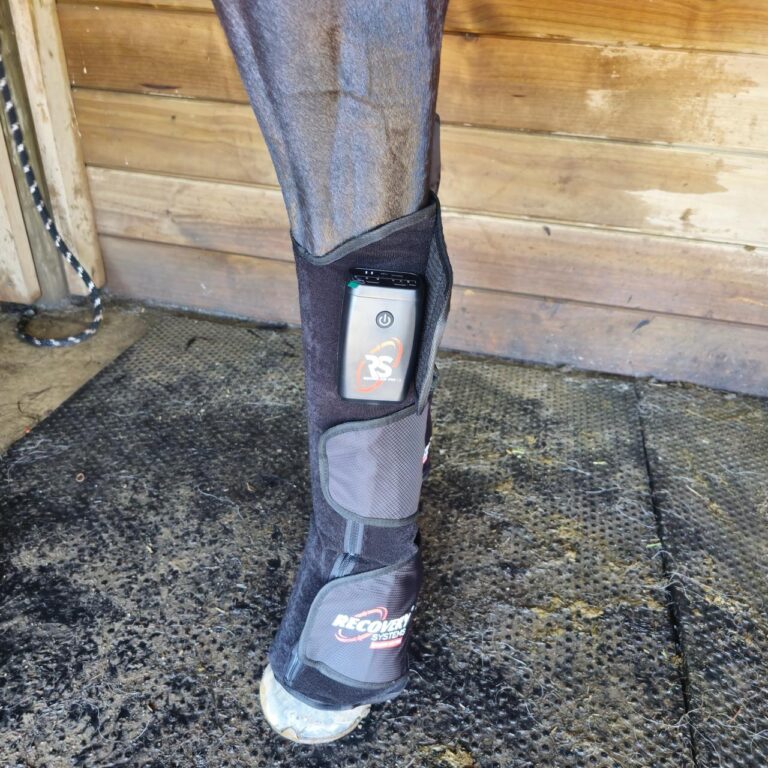
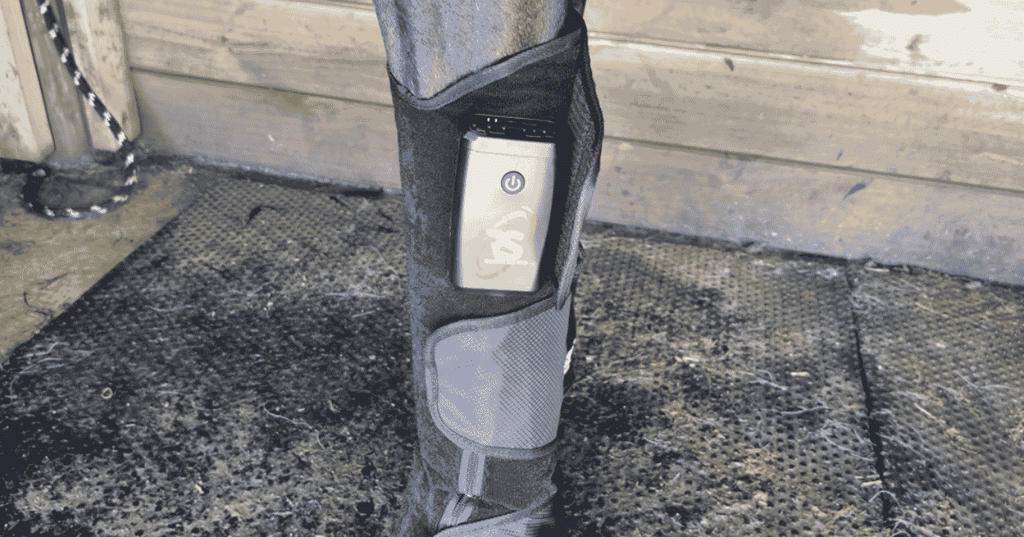
Equine air compression boots are therapeutic devices that enclose a horse’s lower limbs and apply rhythmic, sequential air pressure from the hoof upward. They are the equine equivalent of the pneumatic compression devices used in veterinary and sports medicine to actively drain fluid from limbs.
The boots have multiple air chambers arranged along the length of the limb. A pump inflates each chamber in sequence, starting from the lowest point near the hoof and working upward toward the knee or hock. This pressure wave mimics and amplifies the pumping action a horse’s own muscle contractions provide during movement. When a horse stands still after hard work, those natural contractions stop and fluid pools in the distal limb. The boots keep that drainage process going.
Equine air compression boots are sometimes called horse air compression boots or equine pneumatic compression boots, depending on the manufacturer. The underlying technology is the same across all devices. Each uses sequential chambers, upward inflation, and controlled pressure to drive lymphatic and venous fluid toward the body core.
How Do Compression Boots Work in Horses?
The equine lower limb is uniquely vulnerable to fluid accumulation. Horses carry over half their body weight on their forelimbs, and their distal lymphatic vessels rely almost entirely on movement to pump fluid upward.
Unlike humans, horses have very little muscle mass below the knee and hock. Their lower-limb lymphatic drainage depends almost entirely on the pumping action of the digital cushion, the hoof mechanism, and general limb movement during the walk and trot. When a horse stands still after competition, this pumping action ceases, and fluid that accumulated during exercise has no efficient way to clear.
This is the physiological problem that equine air compression boots solve. By inflating sequentially from the coronary band upward, the boots push fluid past the accessory carpal bone and toward the cubital lymph nodes, the same pathway the horse’s own lymphatic system uses during movement.
What the Research Shows in Horses
The evidence base for this is not only theoretical. A 2023 randomised crossover study published in the American Journal of Veterinary Research tested a pneumatic compression device on six healthy Thoroughbred horses and directly measured lymphatic flow using nuclear imaging technology called lymphoscintigraphy. The results showed that pneumatic compression significantly increased lymphatic flow to the accessory carpal bone and the cubital lymph node compared with untreated control limbs. Both findings were statistically significant with p-values of 0.002 and 0.001, respectively. The study authors concluded that pneumatic compression encouraged lymphatic flow in equine forelimbs and called for further study in horses with clinical lymphedema and drainage disorders.
This is direct equine evidence, measured inside horses using imaging technology, confirming that air compression boots accelerate the exact lymphatic drainage pathway that becomes congested after competition.
When to Use Horse Air Compression Boots
Equine air compression boots deliver the strongest benefit within the first two to four hours after exercise, when exercise-related fluid is still accumulating and the lymphatic system is under its greatest load.
- After cross-country, show jumping, eventing, or intense schooling sessions
- On rest days during multi-day competitions to maintain lower limb health
- As a daily maintenance tool for horses prone to windpuffs or chronic leg filling
- As part of a supervised rehabilitation protocol following tendon or ligament injury
A standard session runs 20 to 30 minutes. For horses in active rehabilitation, daily sessions over consecutive days produce the most consistent results. Always confirm with your equine vet before incorporating any new therapy into a rehabilitation protocol.
Which Horses Should Not Use Compression Boots?
Compression boots are not appropriate for horses with open wounds on the treated limb, active cellulitis or skin infections, suspected thrombosis, or significant arterial insufficiency. If any of these conditions are present or suspected, veterinary assessment must come before starting any physical therapy.
What Is PEMF Therapy for Horses?
Pulsed electromagnetic field therapy, or PEMF, delivers electromagnetic pulses into equine tissue to stimulate biological repair processes at the cellular level. It works from the inside out, targeting cell function deep inside the horse’s body rather than moving fluid mechanically from the surface.
When a PEMF device is applied to a horse’s body, the electromagnetic field passes through skin, muscle, and bone without resistance. As it moves through tissue, it induces a small electrical current at the cellular level. This current interacts with ion channels on cell membranes, modulating calcium ion flow into and out of cells. Calcium signalling governs the inflammatory response, cellular repair, and adenosine triphosphate production, the energy molecule that powers virtually every repair process in the body.
For horses, PEMF can reach tissue that surface-applied therapies cannot access. A tendon injury deep inside the lower limb, an arthritic joint, a stress reaction in a cannon bone, or accumulated tension through a horse’s thoracic spine are all candidates for PEMF treatment in ways compression boots or topical treatments cannot address.
What Research Shows About Equine PEMF Therapy
A 2018 peer-reviewed review published in Research in Veterinary Science documented that PEMF therapy has accumulating clinical evidence across four main veterinary applications. These include bone healing, wound healing, management of osteoarthritis pain, and reducing post-operative pain and oedema in large animals. The review noted that the depth of electromagnetic penetration makes PEMF uniquely useful in veterinary medicine, where horses present with deep structural problems that require a treatment modality capable of reaching inside the body without surgery.
What Is BEMER Therapy for Horses?
BEMER stands for Bio-Electro-Magnetic-Energy-Regulation. It is a registered electromagnetic therapy system that operates at a different level to both compression boots and PEMF machines. BEMER targets microcirculation, specifically the spontaneous, rhythmic contraction of the smallest blood vessels in the horse’s body, known as vasomotion.
Vasomotion is the process by which arterioles and capillaries pump blood through the microvascular network independent of the horse’s main cardiac output. It governs the final delivery of oxygen and nutrients to individual muscle cells and the removal of metabolic waste products from tissue. When fatigue, systemic stress, or the physical toll of competition and travel impairs vasomotion, tissue oxygenation can suffer even when the horse appears outwardly recovered.
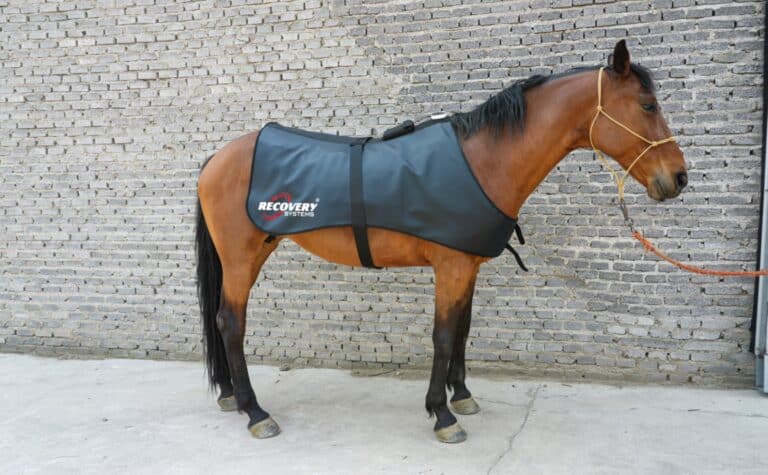
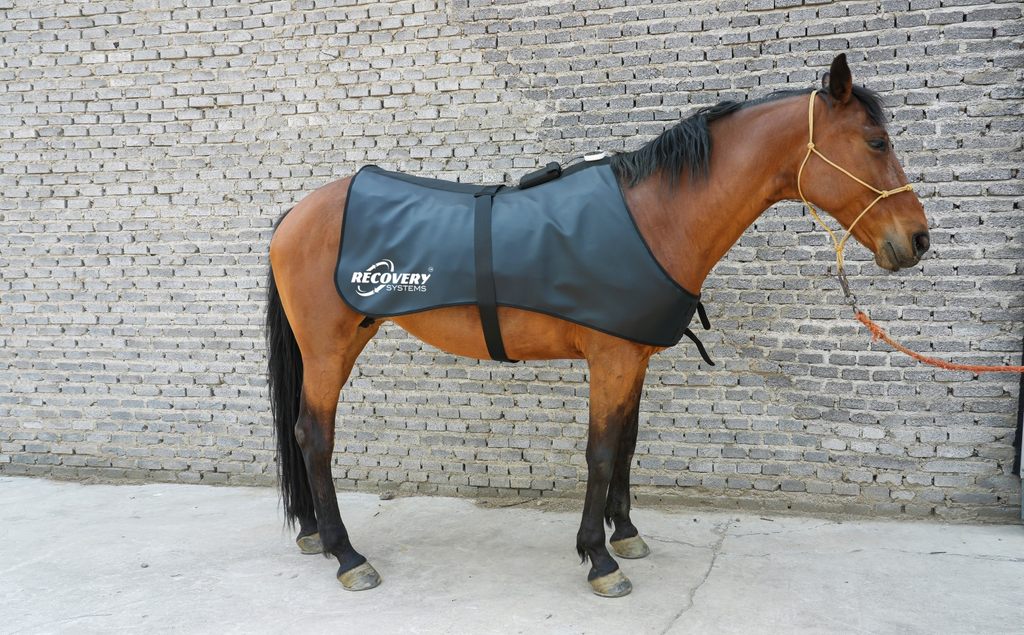
BEMER applies a proprietary low-intensity electromagnetic signal through a purpose-built blanket or pad designed to fit a horse’s anatomy. The signal is applied across the whole body rather than to a specific site, making BEMER a systemic tool rather than a targeted one.
What the Evidence Shows
Equine-specific clinical trials for BEMER are limited. The therapy is widely used across competitive yards, and many equine practitioners report positive responses, particularly in horses showing general circulatory fatigue after heavy competition schedules or long-distance transport. A 2023 pilot study published in Clinical Research in Cardiology demonstrated a 25 per cent improvement in microvascular flow index over four days of BEMER treatment in a clinical setting, providing mechanistic evidence that BEMER’s signal can positively influence microcirculatory perfusion. Applying this finding to horses requires a degree of extrapolation, and measured expectations are appropriate.
How Often Should You BEMER Your Horse?
Standard BEMER protocols for horses involve one to two sessions per day, each lasting eight to twenty minutes. Some trainers use BEMER before exercise to prime the horse’s microcirculatory readiness and again post-exercise as part of the recovery sequence. Daily use is considered safe. Monitoring the horse’s response, looking for signs of improved muscle looseness, calmer post-session demeanour, and reduced stiffness during warm-up, will tell you more than any fixed protocol.
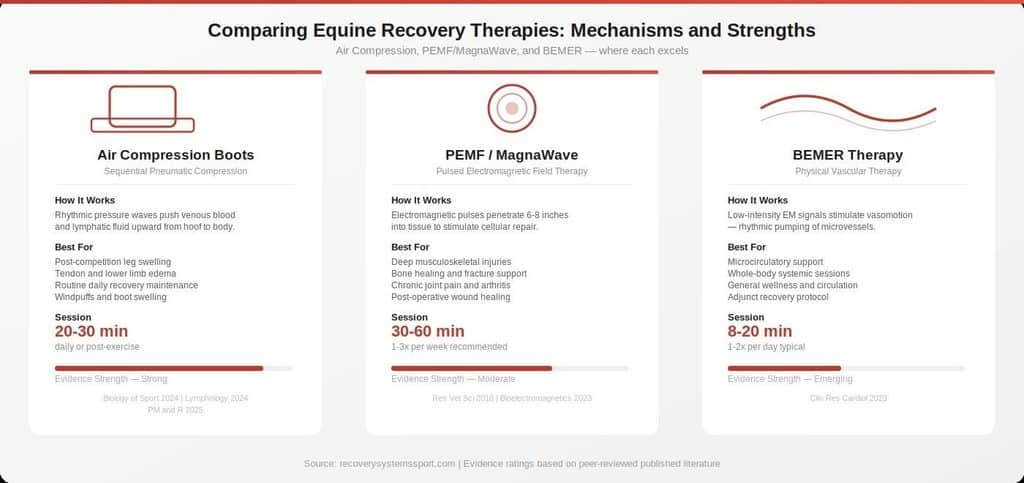
Side-by-side comparison of equine air compression, PEMF/MagnaWave, and BEMER therapy.
Comparing All Three Therapies for Horses
Once you understand each therapy on its own terms, the comparison becomes clear. They don’t compete because they solve different problems inside the horse’s body.
Equine air compression boots address the mechanical problem of fluid accumulation in the horse’s lower limb. They move lymph and venous blood upward through direct physical pressure applied sequentially from hoof to knee. The 2023 AJVR lymphoscintigraphy study confirmed this happens measurably and significantly in horse forelimbs. Compression boots are the right tool when the primary need is rapid fluid clearance after competition or training.
PEMF therapy, delivered through devices such as MagnaWave, addresses the cellular problem of tissue injury and chronic inflammation deep inside the horse’s body. It reaches structures that compression cannot reach, including tendons, bones, joint cartilage, and deep musculature. The 2018 veterinary review confirmed four specific clinical applications in large animals. PEMF is the right tool when the primary need is cellular repair and anti-inflammatory support for a specific site.
BEMER therapy addresses the systemic problem of impaired microcirculatory vasomotion across the whole horse. It works at low intensity across the entire body and is best understood as a general circulation support adjunct for horses under broad physiological recovery stress. It is not a substitute for targeted mechanical drainage or site-specific cellular repair.
Post-Competition Recovery Protocol for Horses
The most effective approach doesn’t rely on a single therapy. It layers all three at the specific phase of equine recovery where each one produces the greatest physiological benefit.
- Immediately After Competition
Cold hosing the lower limbs for 10 to 15 minutes reduces local tissue temperature and slows capillary leakage in the immediate post-exercise window. Follow this with a 20 to 30 minute session in equine air compression boots to keep lymphatic drainage active while the horse stands. Most horses show visible improvement in limb texture and swelling within a single session using this combination.
- Day One to Three Post-Competition
Continue daily compression boot sessions to maintain active fluid clearance. If post-competition assessment reveals specific areas of muscular tension, joint stiffness, or localised soreness through the back or hindquarters, introduce a PEMF or MagnaWave session targeting those sites. BEMER can be incorporated during this phase for horses that have travelled long distances and are showing signs of general circulatory fatigue rather than a specific injury.
- Ongoing Maintenance Through the Competition Season
For horses competing regularly, equine air compression boots used three to five times per week protect lower limb health between events. One PEMF session per week supports the cumulative cellular recovery demands of hard training. BEMER can be used as a short daily session during peak competition periods. Monitor the horse’s legs through daily palpation. Any increase in heat, asymmetric swelling, or change in gait should prompt veterinary assessment before continuing any therapy.
The Bottom Line
Equine air compression boots have direct veterinary evidence confirming they accelerate lymphatic drainage in horse forelimbs. They are the right first-line tool for post-competition lower limb care and for the acute phase of swelling management in tendon and ligament injuries. PEMF therapy, delivered through devices such as MagnaWave, is the right tool for deep structural problems in the horse, including bone healing, osteoarthritis management, wound repair, and subacute soft tissue rehabilitation. BEMER supports systemic microcirculatory function and works best as an adjunct for horses under broad physiological recovery stress, rather than as a targeted treatment for a specific problem.
Your horse works hard. Make sure they recover even harder. Recovery Systems Sport equine air compression boots deliver sequential pneumatic compression directly to your horse’s legs, reducing post-competition swelling, accelerating lymphatic drainage, and supporting a faster return to training.
Frequently Asked Questions
Do equine air compression boots actually work?
Yes, and direct equine evidence supports this. A 2023 randomised crossover study published in the American Journal of Veterinary Research measured pneumatic compression’s effect on lymphatic flow in six Thoroughbred horse forelimbs using lymphoscintigraphy. Compression produced significantly faster lymph clearance at two key anatomical landmarks compared with untreated control limbs. Horse owners who regularly use equine air compression boots after competition report a consistent, visible reduction in post-exercise leg swelling within a single session.
Does BEMER therapy really work for horses?
BEMER has human clinical evidence supporting its effect on microcirculation. A 2023 pilot study in Clinical Research in Cardiology documented a 25 per cent improvement in microvascular flow index over four days of treatment. Equine-specific clinical trials remain limited. BEMER is used across many competitive yards, and practitioners report positive responses, particularly in horses showing systemic fatigue after travel or competition. Measured expectations are appropriate given the current state of equine-specific evidence.
How often do horses need PEMF?
For competition horses in a maintenance programme, equine practitioners most commonly use one to two PEMF sessions per week. In the acute phase of a musculoskeletal injury, practitioners often increase to three sessions per week. Horses managing chronic conditions such as degenerative joint disease or recurring back pain typically receive weekly sessions throughout the competition season.
How often does a horse need MagnaWave?
Most equine MagnaWave practitioners schedule one session per week during regular training, increasing to two or three sessions per week in the acute injury phase. High-powered PEMF devices like MagnaWave are typically administered by trained practitioners. Follow your practitioner’s and equine vet’s guidance rather than a generic schedule.
How often should you BEMER your horse?
Standard equine BEMER protocols involve one to two sessions per day, each lasting 5 to 15 minutes. Some trainers use BEMER before exercise and again after exercise as part of the recovery sequence. Daily use is considered safe and is common on competitive yards that own a BEMER device.
Is magnawave better than bemer for horses?
For a horse with a specific musculoskeletal injury or a localised area of deep-tissue tension, a targeted MagnaWave or PEMF session will almost always be more appropriate than a BEMER session. For a horse that is otherwise sound but showing signs of general circulatory fatigue after a demanding competition season, BEMER may provide useful adjunct support. Which is better depends entirely on the problem the horse is presenting with that day.
Which is best for equine soft tissue injury?
In the acute phase of a tendon or ligament injury, equine air compression boots are the most immediately useful tool because they directly reduce the swelling and tissue tension that impair early healing. Superficial digital flexor tendon injuries and suspensory ligament damage are among the most common causes of performance loss in sport horses, and managing inflammatory swelling in the first days after injury is critical to long-term outcomes. Once the acute phase is controlled, PEMF therapy becomes a more appropriate tool to support cellular repair and tissue regeneration at depth.
How do you reduce swelling in horse legs fast?
The fastest evidence-supported approach for horses combines cold hosing with sequential air compression. Cold hosing for 10 to 15 minutes immediately after exercise slows capillary leakage and lowers local tissue temperature. Follow this with a 20 to 30 minute equine air compression boot session to actively move accumulated fluid out of the limb through the lymphatic system. This combination is more effective than either intervention alone and produces visible improvement in most horses within a single session.
What is a PEMF device for horses and what does MagnaWave do?
A PEMF device for horses generates pulsed electromagnetic fields that penetrate equine tissue to stimulate cellular repair, reduce inflammatory cytokines, and promote energy production inside cells. MagnaWave is a high-powered PEMF machine designed specifically for equine and large-animal use, with coil applicators sized for a horse’s body. According to the 2018 review in Research in Veterinary Science, PEMF has documented veterinary applications in bone healing, wound repair, osteoarthritis management, and post-operative oedema reduction in large animals.
When should you use equine air compression boots?
Use equine air compression boots within the first two to four hours after strenuous competition or training for the strongest lymphatic drainage effect. They are also effective on rest days at multi-day events, during rehabilitation from soft tissue injury, and as a daily maintenance tool for horses prone to windpuffs or chronic leg filling.
Who should not use compression boots on their horse?
Do not use compression boots on horses with open wounds or skin breakdown in the treatment area, active cellulitis or skin infection, suspected blood clotting disorders, significant cardiovascular compromise, or immediately after limb surgery without veterinary clearance.
What is the best therapy for equine soft tissue injury?
In the acute phase, equine air compression boots are the most immediately effective tool for controlling swelling and reducing the tissue tension that can impair early healing. In the subacute and chronic phases, PEMF therapy better supports cellular repair and modulates the inflammatory response deep within the tendon or ligament. Cold therapy, controlled exercise rehabilitation, and veterinary-guided medical treatment remain the foundation of equine soft tissue injury management regardless of which physical therapy modalities are used alongside them.
What is the best recovery method for horse legs after competition?
Based on available equine evidence, a layered approach produces the best results. Cold hosing, followed by equine air compression boots in the immediate post-exercise window, helps clear fluid. PEMF sessions two to three times per week during heavy training support cellular recovery. No single device matches what a structured, multi-modal protocol delivers for competition horse legs.
What Does MagnaWave Do for Horses?
MagnaWave is a high-powered PEMF machine built specifically for equine and large-animal use. It delivers PEMF cellular stimulation at intensities and through coil applicators sized for a horse’s body mass.
A MagnaWave practitioner loops the device coil over the horse’s target area. This might be a superficial digital flexor tendon showing signs of strain after competition, a stiff hock, tightness through the lumbosacral region, or a joint showing early arthritic change. The coil delivers electromagnetic pulses into that specific area, and the session typically runs 30 to 60 minutes depending on what is being treated.
The key difference between MagnaWave and equine air compression boots is one of target and mechanism. Compression boots act across the whole lower limb to move fluid upward. MagnaWave targets a specific injury or site of tension to stimulate cellular repair processes at depth. A horse recovering from a tendon injury will often benefit from both, at different phases and for different reasons.
A 2026 case report in the Journal of Equine Veterinary Science described bilateral superficial digital flexor tendinopathy in a sport horse after the cross-country phase of an eventing competition. The horse was managed with targeted injectable therapy, controlled exercise, and an eight-month rehabilitation programme before returning to showjumping. Cases like this illustrate the layered approach to equine soft tissue recovery that physical therapies including PEMF support in the subacute and chronic phases.
How Often Does a Horse Need MagnaWave or PEMF?
For competition horses in a maintenance programme, equine practitioners most commonly use one PEMF or MagnaWave session per week during heavy training. In the acute phase of a musculoskeletal injury, practitioners typically increase to two or three sessions per week. Horses managing chronic conditions such as degenerative joint disease or recurring back tension often receive weekly sessions throughout the competition calendar. Veterinary assessment and the horse’s individual response guide the right frequency.
What Is a PEMF Machine for Horses?
A PEMF machine for horses is a pulsed electromagnetic field device that generates controlled electromagnetic pulses and delivers them deep into equine tissue. The pulses pass through skin, muscle, and bone to stimulate cellular repair, modulate inflammatory signalling, and support cellular adenosine triphosphate production. A 2018 review published in Research in Veterinary Science confirmed that PEMF has documented veterinary applications in bone healing, wound repair, osteoarthritis management, and post-operative oedema reduction in large animals.
MagnaWave is one of the most recognised brands of high-powered PEMF machines for horses, with coil applicators specifically sized for equine anatomy.
What Does MagnaWave Do for Horses?
MagnaWave for horses is a high-powered PEMF equipment brand designed specifically for equine and large-animal use. A MagnaWave practitioner applies the device coil over the target area, whether that is a strained tendon, a stiff hock, lumbosacral tension, or a joint showing early arthritic change. Electromagnetic pulses penetrate tissue to reach structures surface therapies cannot access.
MagnaWave for horses is typically scheduled once per week during regular training and increased to two or three sessions per week in the acute injury phase. The key difference between MagnaWave and equine air compression boots is that compression moves fluid mechanically while MagnaWave stimulates cellular repair at depth.
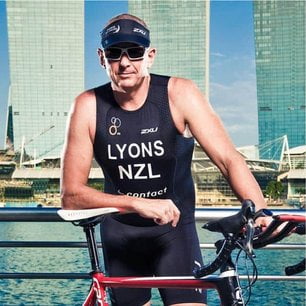
| WRITTEN BYMichael LyonsMichael Lyons is a recovery specialist with three decades of tech and Meditech experience and 15,000+ hours in endurance sports coaching. The author is not a licensed physician or medical professional. The health information in this article represents the author’s research and personal perspective, not professional medical advice. MEDICALLY REVIEWED BYAyman Shafique, PharmDAyman Shafique is a licensed pharmacist with expertise in pharmacology and medical writing. Her work focuses on reviewing and developing evidence-based health and wellness content, ensuring scientific accuracy, clarity, and alignment with current pharmaceutical research. She specialises in translating complex pharmacological and medical information into accessible, reliable content for public and professional audiences. |
| Medical DisclaimerThis article is for informational and educational purposes only and should not be considered medical advice. The author is a recovery specialist, not a licensed medical doctor or healthcare provider. Health-related claims discussed in this article are based on emerging research and should not replace professional medical consultation. Many claims remain theoretical and require further scientific validation. Individual results may vary, and these concepts are not widely accepted as standard medical practice. Before using any therapy device or making health decisions based on this article, please consult a qualified healthcare professional, especially if you have pre-existing medical conditions, are pregnant, have implanted medical devices such as pacemakers, or are taking medications.Commercial Disclosure: This website sells equine recovery products, including air compression boots. The author and company have a commercial interest in promoting these products. Content is written to be as accurate and balanced as possible, and all product recommendations are supported by the cited research context. |
Originally Published::
Author:
Michael Lyons is a biohacking and recovery specialist with three decades of tech and Meditech experience and 15,000+ hours in endurance sports coaching.