
Why Your Horse Has a Swollen Leg and How to Treat It
Last Updated::
A swollen leg on a horse can mean almost nothing or demand an emergency call. The same puffy appearance can come from a horse standing in for a rest day, a torn tendon fibre, a spreading bacterial infection, or a long-term condition quietly worsening under the skin.
Getting this right matters. This guide explains each type of swelling, what triggers it, and which treatments are supported by research.
Why Do Horses Get Swollen Legs?
Horses are naturally prone to leg swelling. Their lower limbs carry most of the body’s weight, have very little muscle below the knee and hock, and depend almost entirely on movement to drain fluid upward.
The body has a drainage network called the lymphatic system. It collects excess fluid from tissue and sends it back into circulation. In a horse’s lower limb, this system has no pump of its own. It relies on the physical squeezing created by hoof impact and leg movement during walking.
When horses spend long periods in box housing with limited movement, it puts the lymphatic system under strain even in healthy horses. Even a small skin wound can lead to serious swelling because the drainage is already slowed.
The Four Types of Equine Leg Swelling
Before choosing any treatment, identify what type of swelling you are looking at. Getting it wrong leads to either unnecessary panic or a dangerous delay.
1. Stocking Up
Stocking up is the most common and least serious type. It happens when a horse stands still for a long time such as during a rest day, long travel, or box rest. Without movement, drainage stops and fluid builds up in the lower leg.
The swelling is soft, appears in both hind legs at the same time, and causes no heat or pain. It clears within twenty to thirty minutes of walking. It is not a health problem on its own, but horses that fill severely during rest may benefit from compression boot sessions.
2. Injury Swelling
When a tendon or ligament is damaged, the body sends fluid and immune cells flooding into the area as part of the repair process. The swelling sits around the injury site in one leg, feels warm, and is sensitive when pressed.
The structures most commonly involved in sport horses are the superficial digital flexor tendon, the suspensory ligament, and the deep digital flexor tendon.
A 2024 review in Veterinary Sciences by researchers at the University of Porto confirmed that tendon and ligament injuries are among the most common problems in sport horses. Quick, accurate diagnosis and early swelling management significantly improve the chances of the horse returning to competition.
A large study in the Equine Veterinary Journal tracked 469 Thoroughbred racehorses in Hong Kong after tendon injuries. Researchers found that how much of the tendon was damaged on the first ultrasound scan was the strongest predictor of whether the horse ever raced again. Horses with smaller damage had a 29 to 35 percent chance of returning to racing. Horses with larger damage covering more than half the tendon had only an 11 to 16 percent chance.
3. Infection
Cellulitis and lymphangitis are bacterial infections that cause some of the most alarming swelling horse owners encounter. Bacteria get in through broken skin such as a wound, a scratch, an injection site, or an area of mange.
The leg becomes hard, hot, and very painful. It usually affects just one limb and can visibly spread up the leg within hours. The horse is typically lame and may run a temperature.
A study of 63 horses with confirmed limb infections in The Veterinary Record found that Staphylococcus aureus and Streptococcus bacteria were most commonly responsible. The study found that 89 percent of horses recovered fully when treated promptly with broad-spectrum antibiotics. The horses that did not survive developed laminitis in the opposite leg from sustained pain and weight-shifting.
Cellulitis and lymphangitis are veterinary emergencies. Compression boots must not be used over an active infection. Call your vet immediately.
4. Chronic Progressive Lymphedema
Chronic progressive lymphedema, known as CPL, is a long-term condition seen mainly in feathered draft horse breeds including Clydesdales, Shires, and Belgians. It starts as recurring swelling in the lower legs and gets worse over years. The skin thickens, deep folds form, and the surface can become crusty and ulcerated.
One of the earliest detailed studies of CPL, published in Lymphatic Research and Biology by De Cock and colleagues at UC Davis, examined six affected horses and found that the lymphatic vessels become thick-walled and stop draining properly. The tissue progressively scars over time. There is no cure.
A 2025 study from Ghent University in Veterinary Research Communications examined 156 Belgian draft horses and found more than nine in ten had active Chorioptes bovis mite infestations, and more than eight in ten showed visible CPL signs. Horses with mites were roughly twice as likely to show CPL signs as those without. Mites were found in foals as young as six days old.
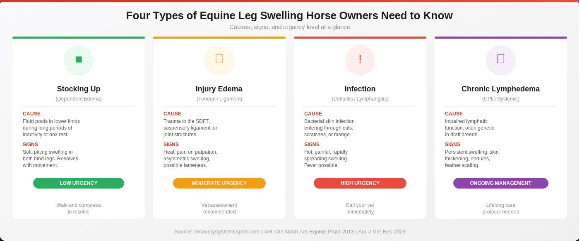
The four types of equine leg swelling at a glance: cause, signs, and how urgently you need to act.
What Causes Horses’ Legs to Swell Up?
Each type of swelling has a different cause. Knowing which one you are dealing with determines everything that comes next.
1. Failure of the Lymphatic Pump
Horses have no independent pump in their lower limb lymphatic system. Movement is the only thing that drives fluid upward. When a horse stands still for hours, fluid pools in the legs by default. This is stocking up. It is not a disease, it is a physiology problem. In horses with CPL, the lymphatic vessels are permanently thick-walled and damaged. Even with movement, fluid does not drain properly, so these horses need lifelong compression and manual drainage support
2. Response of Inflammation to Injury
When tissue is damaged, the body floods the area with fluid as part of the healing response. This swelling is normal and necessary, but too much for too long becomes the problem. Excess fluid increases tissue tension and slows blood flow, which can slow healing
3. Entry of Bacteria into Tissue
Cellulitis and lymphangitis start when bacteria get through broken skin. Entry points include unwashed wounds, areas of chorioptic mange, and poorly healed injection sites. The resulting swelling is faster, hotter, harder, and more painful than any other type. Without antibiotics, the infection can spread up the limb and permanently damage lymphatic vessels. In severe cases it triggers laminitis in the opposite leg from sustained pain and weight-shifting
Treatment of Swollen Horse Legs
The right treatment follows from the right diagnosis. There is no single approach that works across all four types.
1. Treatment of Stocking Up and Post-Exercise Swelling
The goal is to restart the drainage process and clear fluid out of the lower limb. The most supported approach combines cold therapy with compression.
Cold water hosing for ten to fifteen minutes slows the rate at which new fluid leaks into tissue. Research in the Equine Veterinary Journal by Haussler and colleagues at Colorado State University found that cold therapy reached therapeutic temperatures deep in the tissue around the tendon. Adding compression alongside cold produced even lower temperatures than cold alone.
For drainage of fluid specifically, a 2023 study at North Carolina State University in the American Journal of Veterinary Research used a nuclear imaging scan to watch pneumatic compression move lymphatic fluid through horse forelimbs in real time. In legs fitted with a compression device, fluid reached two key points in the lymphatic pathway significantly faster than in untreated legs. It is the clearest direct evidence in real horses that compression actively clears fluid from the lower limb.
The practical routine is cold hosing for ten to fifteen minutes followed immediately by a twenty to thirty minute compression boot session.
2. Treatment of Injury-Related Swelling
Injury swelling requires a vet from the start. In the first 24 to 72 hours the priority is controlling swelling and protecting the injured area. The standard first-line approach includes rest, cold therapy, and support bandaging.
Once a vet has assessed the injury, phenylbutazone (commonly called bute) is the most widely used anti-inflammatory in horses with tendon or ligament injuries. It is available as an oral paste or powder and is used under vet prescription. A second option is flunixin meglumine, used when systemic inflammation is more of a concern.
Compression boots can be introduced once the vet has cleared the acute phase. In the recovery phase, controlled walking, guided rehabilitation, and ongoing compression sessions support healing.
For significant soft tissue injuries, regenerative treatments including platelet-rich plasma injections and stem cell therapy are increasingly used alongside conventional care. These are specialist vet decisions and are not appropriate as self-managed treatments.
3. Treatment of Cellulitis and Lymphangitis
Bacterial infection of the lower limb requires systemic antibiotics started as soon as possible. There is no physical therapy substitute for this.
The most commonly used antibiotics in confirmed equine cellulitis cases include procaine penicillin and potentiated sulphonamides for Streptococcus-type infections, and trimethoprim-sulfamethoxazole as a broad-spectrum oral option. Alongside antibiotics, phenylbutazone or flunixin meglumine are used under vet direction to control pain and reduce inflammation. In cases with fluid pockets under the skin, ultrasound-guided surgical drainage is sometimes needed.
Cold hosing can provide some comfort but does not address the infection. Compression boots must not be applied while infection is present in the limb.
4. Management of Chronic Progressive Lymphedema
CPL cannot be cured. The goal is to slow its progression, keep skin infections under control, and maintain the horse’s quality of life through consistent daily care.
Keeping the feathered hair clipped short is the starting point. It makes the skin visible for monitoring, reduces the moist environment that mites and bacteria thrive in, and lets topical treatments reach the skin directly.
For mite control, topical ivermectin and fipronil-based sprays are the treatments most commonly used for Chorioptes bovis infestations. These should be selected and applied under vet guidance since Chorioptes can be persistent and may need repeated treatment cycles.
Daily gentle walking keeps the lymphatic system as active as possible. Compression bandaging between sessions helps prevent accumulated fluid from turning into fibrous scar tissue, which is much harder to shift.
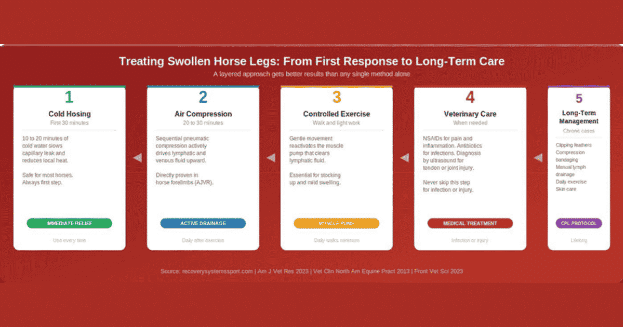
From first response to long-term care: a practical five-step treatment guide for equine swollen legs.
Reduction of Swelling in Horse Legs Fast
For post-exercise or post-competition swelling, time matters. The sooner fluid is cleared after hard work, the less chance it has to become the denser, harder swelling that takes days to shift.
The fastest evidence-supported sequence is cold hosing for ten to fifteen minutes followed immediately by a twenty to thirty minute compression boot session. Cold slows the inflow of new fluid. Compression actively clears what has already built up. The two steps work together, not as alternatives.
For horses that resist cold hosing, cold water bandages or ice boots provide a similar cooling effect. If only one step is possible, prioritise the compression boot session because that is where active drainage happens.
Horses that receive regular compression sessions during competition seasons tend to maintain lower baseline leg filling than horses without this routine. Prevention is much easier than clearing established swelling.
Other Methods of Swelling Management in Horses
- Daily walking and free turnout to restart the natural drainage process
- Walking the horse out fully after exercise before stabling
- Support bandaging during extended box rest to provide passive compression
- Vet-prescribed phenylbutazone for confirmed tendon or joint inflammation
- Prompt antibiotic treatment under vet direction when infection is suspected
- Feather clipping and regular skin checks for horses prone to CPL or mite infestation
Signs That Require a Vet Call
Soft swelling in both hind legs that clears with a short walk is almost always stocking up and does not need vet involvement. Everything below does.
- Swelling in one leg only, with or without lameness
- Swelling that is hard or hot rather than soft and doughy
- A temperature or elevated heart rate alongside swollen legs
- Swelling spreading up the limb rather than staying in one place
- Any wound, skin break, injection site, or area of mange near the swelling
- Swelling that has not reduced after 24 to 48 hours of appropriate management
- Any known or suspected tendon, ligament, or joint injury
A horse with one swollen leg and no lameness can easily look lower priority than it is. Early infection may not cause obvious lameness for the first few hours. An early tendon strain may not yet be painful enough to show in the gait. When in doubt about any single-limb swelling, calling the vet for advice costs very little and protects both the horse and the owner.
Get fluid out of your horse’s legs faster. Every session, every time.
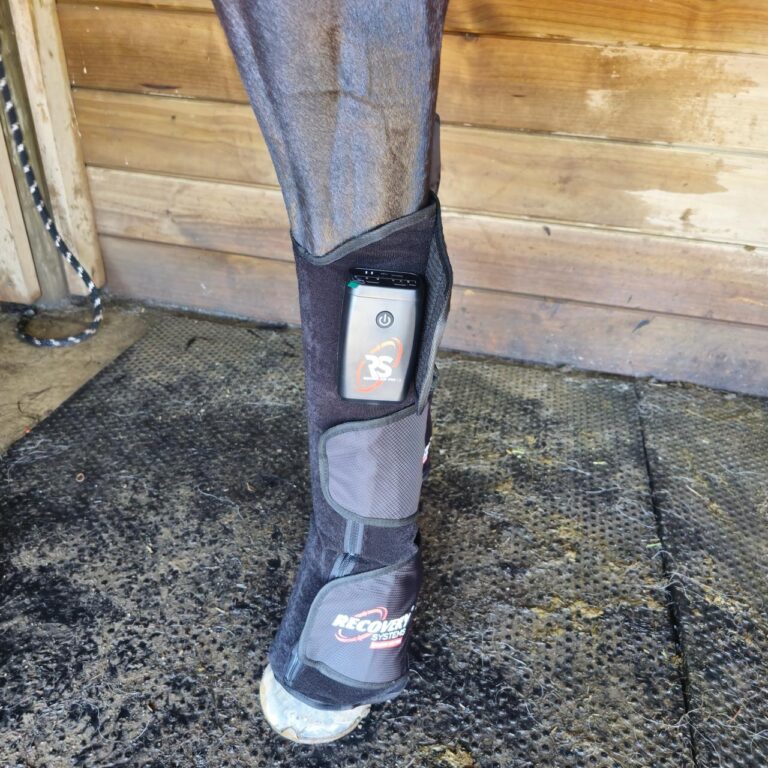
Recovery Systems Sport equine air compression boots use sequential pneumatic compression to actively drain lymphatic fluid from the lower limb, reducing post-competition swelling and supporting a faster return to training.
The Bottom Line
Horse leg swelling is not one problem. Stocking up from inactivity responds to movement and compression. Injury swelling needs early accurate diagnosis, vet-guided treatment, and phased physical therapy. Bacterial infection is an emergency that needs antibiotics immediately. Chronic progressive lymphedema in draft breeds needs lifelong daily management. Movement keeps the lymphatic system working. Cold therapy slows acute fluid accumulation. Compression actively drains fluid that has already built up. Veterinary treatment handles the causes that physical therapy cannot reach on its own.
The best outcomes come from responding early, identifying the cause correctly, and combining the right tools at the right stage.
Frequently Asked Questions
How Do You Treat a Horse’s Leg Swelling?
Treatment depends on the cause. Stocking up clears with movement and a compression boot session. Research at North Carolina State University, published in the American Journal of Veterinary Research, directly confirmed in real horses that compression moves lymphatic fluid out of the lower limb faster. Injury swelling needs vet assessment, imaging, and a step-by-step rehab plan. Infection needs prompt antibiotics such as procaine penicillin or potentiated sulphonamides under vet direction. CPL needs lifelong management with compression, skin care, mite control, and daily movement.
How Do You Treat Edema in Horses?
Equine edema management works best as a layered approach. For post-exercise swelling, cold hosing followed by compression boots is the most direct evidence-supported sequence. For inflammatory swelling from injury, vet-prescribed anti-inflammatory drugs alongside physical therapy address both cause and symptom. The most effective approach combines these tools in the right order rather than relying on any single method.
How to Reduce Swelling in Horse Legs?
For routine post-exercise swelling, cold hosing for ten to fifteen minutes followed immediately by a twenty to thirty minute compression boot session is the fastest combination supported by equine research. For mild stocking up, twenty minutes of active walking often clears the fluid. For any swelling with heat, pain, lameness, or a temperature, get vet advice before applying any physical therapy.
What Causes Horses’ Legs to Swell Up?
The four main causes are inactivity slowing lymphatic drainage, soft tissue injury triggering the inflammatory response, bacterial infection producing rapid aggressive local swelling, and chronic progressive lymphedema in predisposed draft breeds where the lymphatic vessels are structurally impaired. The most common thing horse owners see is stocking up, which is benign. The most urgent sign is a single hot swollen leg with a temperature, which points to infection and needs a vet immediately.
What Helps with Swelling in Horses?
Daily movement is the foundation of both prevention and management. Cold therapy after exercise slows fluid accumulation. Equine air compression boots are the most direct evidence-based method for actively clearing pooled fluid from the lower limb. Compression bandaging supports horses on box rest. Vet-prescribed anti-inflammatories such as phenylbutazone address underlying inflammatory conditions. No single method matches the effectiveness of combining these approaches in the right order.
Why Is My Horse’s Leg Swollen but Not Lame?
Soft swelling in both hind legs without lameness is almost always stocking up and is generally not a concern. Single-limb swelling without lameness is more important to watch. Early tendon damage can produce visible swelling before the pain is severe enough to affect the gait. Early cellulitis can present with heat and swelling before systemic signs develop. A single swollen leg without lameness should be monitored and assessed by a vet if it does not resolve within 24 hours, if heat or pain develops, or if the swelling starts to spread.
What Is the Most Effective Treatment for Equine Swelling?
The most effective treatment for equine swelling depends on the type of swelling present. For post-exercise and stocking-up swelling, the best treatment for horse leg swelling combines cold hosing with sequential pneumatic compression. Cold therapy slows new fluid from entering the tissue while compression actively drains what has already built up.
A 2023 study in the American Journal of Veterinary Research confirmed that compression significantly accelerated lymphatic fluid clearance in horse forelimbs. For injury-related swelling, veterinary assessment and anti-inflammatory medication form the foundation of care. For infection, systemic antibiotics are the only effective first-line treatment.
The best recovery method for horse legs uses the right combination of tools matched to the specific cause rather than relying on a single approach.
What Causes Equine Edema and How Should It Be Managed?
Equine edema is the accumulation of excess fluid in the soft tissues of the horse’s lower limbs. It occurs because horses have no independent lymphatic pump below the knee and hock. Drainage relies entirely on movement.
When horses stand still for long periods, equine edema develops as fluid pools in the legs by default. Edema horses present with can range from soft bilateral filling that clears with a short walk to firm single-limb swelling that signals injury or infection. Managing equine edema from inactivity is straightforward.
Walking restarts the drainage process and compression boots accelerate it. Edema horses develop from tendon damage, cellulitis, or chronic progressive lymphedema requires veterinary diagnosis and a targeted treatment plan. A horse swollen leg that is warm, hard, or limited to one limb should always be assessed by a vet before any physical therapy is applied.
Why Is My Horse’s Leg Swollen but Not Lame?
A horse swollen leg without lameness is most commonly stocking up from prolonged standing. The swelling is soft, appears in both hind legs, and clears within twenty to thirty minutes of walking. This is not dangerous on its own.
However, a horse swollen leg that is warm, affects only one limb, or does not resolve with movement may indicate an early tendon strain or the beginning of a bacterial infection. Early-stage cellulitis may not produce obvious lameness for the first few hours. A horse swollen leg that persists beyond 24 hours or is accompanied by heat warrants veterinary assessment.
When in doubt, calling the vet costs very little and protects against a delayed diagnosis that could have been caught earlier.
| MEDICALLY REVIEWED BY Ayman Shafique, PharmD Ayman Shafique is a licensed pharmacist with expertise in pharmacology and medical writing. Her work focuses on reviewing and developing evidence-based health and wellness content, ensuring scientific accuracy, clarity, and alignment with current pharmaceutical research. She specialises in translating complex pharmacological and medical information into accessible, reliable content for public and professional audiences. |
| Medical Disclaimer: This article is for informational and educational purposes only and should not be considered medical advice. The author is a recovery specialist, not a licensed medical doctor, veterinarian, or healthcare provider. Health-related claims discussed in this article are based on emerging research and should not replace professional veterinary consultation. Many claims remain theoretical and require further scientific validation. Individual results may vary. Before using any therapy device on your horse or making health decisions based on this article, please consult a qualified equine veterinarian, especially if the animal has existing injuries, infections, cardiovascular conditions, or is undergoing post-surgical recovery. Commercial Disclosure This website sells equine recovery products including air compression boots. The author and company have a commercial interest in promoting these products. Content is written to be as accurate and balanced as possible, and all product recommendations are supported by the cited research context. |
Originally Published::

Author:
Michael Lyons is a biohacking and recovery specialist with three decades of tech and Meditech experience and 15,000+ hours in endurance sports coaching.