
Recovery Travel: Why More Wellness Travellers Are Packing Compression Boots and Portable Recovery Tech
Last Updated::
There’s a specific kind of traveller who used to pack noise-cancelling headphones and a good book, and now packs those things alongside a pair of compression boots. If that sounds like an oddly specific observation, it’s because it reflects something real happening in how people think about travel — and the data backs it up.
The trip is no longer just an escape
For a long time, travel and wellness were treated as two separate categories: you either went somewhere to relax and unwind, or you went somewhere specifically to “do wellness” — a spa retreat, a yoga intensive, a detox week. Increasingly, that line is dissolving. Wellness is being woven into travel generally, not treated as its own separate category of trip.
That shift shows up clearly in the numbers. The global wellness economy reached an estimated $6.8 trillion in 2024, according to the Global Wellness Institute’s 2025 Global Wellness Economy Monitor — having roughly doubled since 2013 — and is projected to approach $9.8 trillion by 2029. Wellness tourism, specifically, is one of the sectors the Institute expects to surpass the $1 trillion mark by 2029, growing faster than the broader travel industry. Separate market research on the wellness tourism sector puts 2025 revenue in the range of roughly $975 billion to $1 trillion, with continued strong growth projected through the next decade — figures that vary somewhat by methodology but consistently point in the same direction: this is one of the fastest-growing categories in global travel.
Why “recovery” is becoming its own travel priority
A few things are converging here.
Business and leisure travel are blending. The rise of “bleisure” travel — extending work trips for leisure, or building wellness routines into business travel — means more people are trying to maintain physical recovery habits on the road, not just during dedicated wellness trips. Hotel groups have taken notice: several major hospitality brands have expanded dedicated wellness programming across their properties over the past year, integrating recovery-adjacent offerings such as sleep-focused rooms and recovery-oriented spa menus alongside traditional amenities.
Long-haul travel takes a real physical toll. Anyone who has stepped off a long-haul flight with swollen ankles and a stiff lower back knows this isn’t abstract. Long periods of immobility during travel are associated with reduced circulation and increased leg swelling — which is exactly the kind of problem portable compression therapy is designed to address, making it a genuinely practical travel companion rather than just a trend.
Preventive and longevity-focused travel is growing. Medical and longevity travel — trips built around health optimisation rather than illness treatment — is one of the wellness economy’s more notable growth areas, reflecting a broader shift from reactive to preventive approaches to health, including while travelling.
What “packing for recovery” actually looks like now
The wellness traveller’s kit has expanded well past sunscreen and a yoga mat. What’s increasingly common:
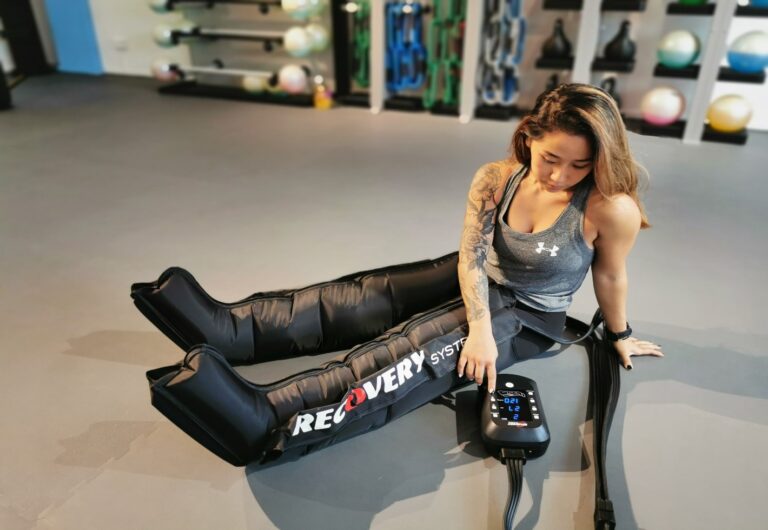
- Portable compression devices for long flights and after activity-heavy travel days — small enough to pack, powerful enough to make a real difference to how your legs feel the next morning.
- PEMF and far-infrared tools are used as part of an evening wind-down routine, particularly relevant for travellers dealing with jet lag and disrupted sleep schedules.
- Recovery-focused spa and hotel amenities, which more properties are adding specifically because guests are asking for them — not just massage and sauna, but structured recovery protocols.
This isn’t just a niche interest for elite athletes anymore. It reflects a broader consumer shift: people increasingly think of feeling good during and after a trip as part of what they’re paying for, not an afterthought.

What this means if you travel often
If you travel regularly — for work, for sport, or simply because you love it — a few practical takeaways from where this trend is heading:
- Portable recovery gear earns its space in a suitcase. A compact compression device is a genuinely useful addition for long-haul flights or multi-day trips that involve a lot of walking, standing, or other physical activity.
- Build a recovery routine into travel days, not just training days. The same principles that apply to recovering from a hard workout apply to recovering from twelve hours in economy class: circulation, gentle movement, and a wind-down routine before sleep all help.
- Look for properties that take recovery seriously. As more hotels and resorts add dedicated wellness and recovery programming, it’s worth factoring that into where you choose to stay — particularly for trips where you know you’ll be pushing your body, whether that’s skiing, hiking, or simply back-to-back meetings across time zones.
The bottom line
Wellness tourism isn’t a passing trend — it’s one of the fastest-growing parts of a genuinely enormous global wellness economy, and recovery is increasingly central to how it’s expressed. Travellers aren’t just looking to relax anymore; they’re looking to travel in a way that doesn’t leave them depleted when they get home. Packing recovery tech alongside your usual travel essentials isn’t excessive — it’s a reasonable response to how much the modern trip actually asks of your body.
Sources
Global wellness economy figures are drawn from the Global Wellness Institute’s 2025 Global Wellness Economy Monitor (released in November 2025), which estimates the global wellness economy at $6.8 trillion in 2024 and projects it to reach approximately $9.8 trillion by 2029. Wellness tourism market size estimates (approximately $975 billion–$1 trillion for 2025) are drawn from independent market research reports; these figures vary by methodology and should be verified against the specific source before use in external materials. Findings on circulation and prolonged immobility during travel reflect established medical understanding of venous circulation; readers with specific health concerns, including risk factors for deep vein thrombosis, should consult a doctor before long-haul travel.
About the Author
Michael Lyons
With three decades of tech and Meditech experience and 15,000 hours of endurance sports coaching and competing at the NZ national team level, Michael’s passion is biohacking recovery and wellness for athletes, for those with short- and long-term medical conditions, and healthy ageing.
Michael consults and partners with leading medical practitioners to provide therapy solutions for short- and long-term illnesses, including diabetes, DVT, lymphedema, pre- and postnatal, post-surgery, autism (ASD), PTSD, and sleep apnea.
On the athlete side, Michael consults and partners with high-performance sports organisations, three Olympic gold medalists, two current world champions, the Rugby World Cup, NZ Rugby, the Singapore Olympic team, the NZ Olympic team, clubs and coaches. He also teaches the recovery modules for the fitness industry’s personal training courses.
Originally Published::
Author:
Michael Lyons is a biohacking and recovery specialist with three decades of tech and Meditech experience and 15,000+ hours in endurance sports coaching.